
A Primer on Owlet

Owlet (OWLT) produces devices and apps for baby monitoring. Its most well-known product is DreamSock, a $299 smart FDA-cleared baby monitor measuring heart rate, oxygen saturation, and sleep quality (even predicting the baby’s next sleep window).
The company’s pediatric data software platform, Owlet360, is rapidly gaining subscribers (110K by early March 2026), and the company is engaging with AI to leverage its vast proprietary pediatric data trove.
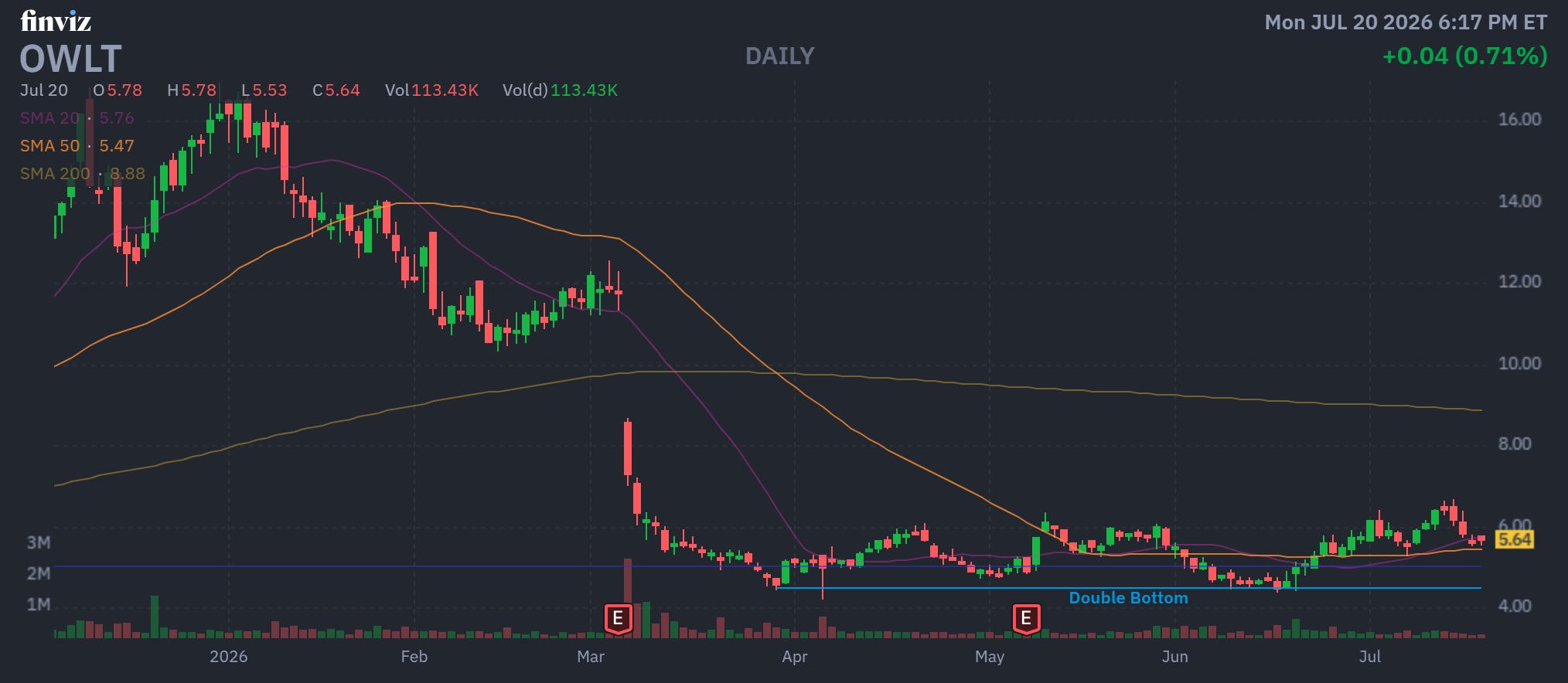
The shares, which had rallied strongly late last year, collapsed after the Q4/25 results disappointed and haven’t recovered:
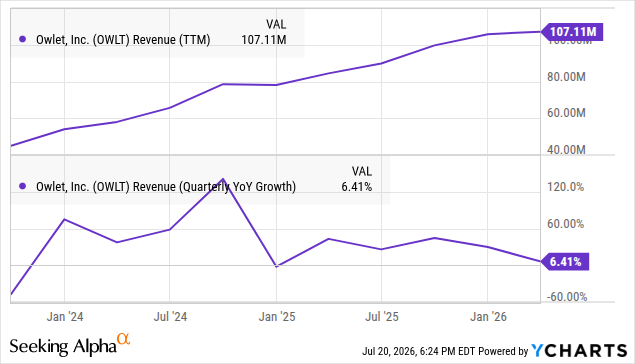
Growth indeed slowed down markedly, from the mid-30s in FY25 to just 6.4% in Q1/26:
We’ll get into that, and the prospects for the company in an upcoming article; first, here is the Primer to help you familiarize yourself with the moving parts of the company:
Company Overview
Owlet is a leading pediatric health platform and the only company globally providing both FDA-cleared and internationally medically-certified wearable pediatric monitors for home use.
The company’s ecosystem consists of wearable monitoring systems, an integrated video platform, and a mobile app designed to bridge the gap between hospital care and home wellness.
Owlet has served over 2.5M parents since 2012, leveraging one of the largest proprietary datasets of infant health and sleep information to drive its AI-powered platform; see its first Baby Sleep Report from data of 1.2M monitored baby’s using an Owlet device.
The core vision is to transition from reactive monitoring to proactive, data-informed pediatric wellness.
On April 6, 2026 Kurt Workman, Executive Chair of the Board, co-founder, and former CEO, became CEO again when Jonathan Harris resigned as President and Chief Executive Officer.
As of December 31, 2025, the company had 108 full-time employees.
Integrated Product Portfolio
Dream Sock: An FDA-authorized wearable monitor utilizing pulse oximetry to track heart rate and oxygen levels. It provides Live Health Readings and notifications to caregivers if values move outside preset ranges.
BabySat: A prescription-only version of the wearable monitor for high-risk infants (e.g., those with RSV or pneumonia). It is FDA-cleared in the US and allows for customizable alarm limits under physician supervision.
Dream Sight: A smart audio/video monitor featuring 2k HD video, motion/cry detection, and the SGS Cybersecurity Mark for high digital safety standards.
Dream Duo: A combined offering of the Dream Sock and Dream Sight that provides a holistic view of a child’s health and safety. Dream Duo 3 was named the Best for Monitoring Baby’s Health’ in PARENTS 2026 Best for Baby Awards
Accessories: Includes fabric accessory socks and travel cases.
The Owlet360 Subscription Service
Launched in January 2025, the service gained over 98K subscribers by the end of the year and recently surpassed 110K paying subscribers.
Priced at $9.99 per month, it provides personalized health and sleep insights derived from Owlet’s vast pediatric dataset.
The service is a key pillar in Owlet’s transition to a software-led platform, driving predictable recurring revenue and increasing customer lifetime value (LTV).
Currently available in English-speaking markets (US, UK, Ireland, South Africa, Australia, New Zealand), with plans for additional languages and markets in FY26.
Growth Pillars
Leveraging its status as the only FDA-authorized over-the-counter monitor in its category to increase U.S. market share.
New products:
International expansion: Dream Sock holds seven international regulatory clearances (EU, UK, Australia, New Zealand, South Africa, India, and Israel) and is sold in over 30 countries. The company launched Dream Sight and Dream Duo 3 in Australia and New Zealand May 2026.
Healthcare channels: Expanding BabySat adoption through insurance reimbursement, which is now available in 37 states on Medicaid and through over 250 commercial carriers.
Hospital partnerships: are another growth vector with the consignment agreement with Children’s Hospital of The King’s Daughters (CHKD) to prescribe devices directly to patients upon discharge.
Strategic partnerships, like the one with PromptCare to expand distribution of BabySat, its prescription pediatric pulse oximeter or with WebAI to “to accelerate the development of secure, personalized, and data-driven intelligence across the Owlet product ecosystem.”
Regulatory and Research Leadership
In 2023, Owlet transitioned from a consumer tech firm to a medical device company with 510(k) clearance for BabySat and De Novo authorization for Dream Sock.
Current investments are centered on AI and computer vision for camera products and AI-driven personalization for wearables.
The company is exploring sensors for temperature trends and hydration indicators.
Manufacturing and Operations
Owlet relies on third-party manufacturers, primarily Benchmark Electronics (Thailand) for Dream Sock and BabySat, and Aoni (China/Vietnam) for Dream Sight.
Plans are underway to expand manufacturing with Benchmark to a new site in Mexico in 2026.
The digital ecosystem is hosted on a hybrid cloud platform using Google Cloud Platform (GCP) and Amazon Web Services (AWS).
FY25 Finances
Revenue was up 35.4% to $105.7M.
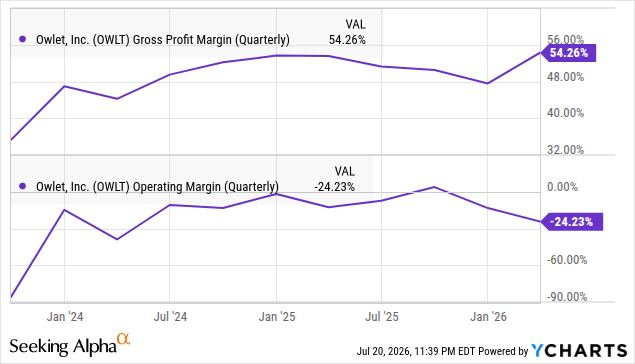
Gross margin increased 20bp to 50.6%, despite global trade headwinds.
Adjusted EBITDA was $2.0M, marking the company’s first full year of positive Adjusted EBITDA.
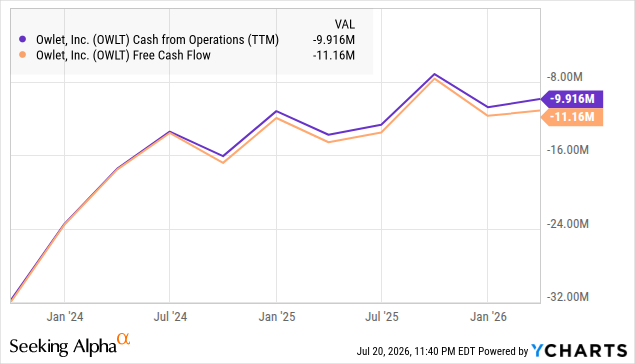
The company reported a net loss of $39.7M for FY25.
Financial stability was bolstered by a successful warrant exchange and a follow-on equity offering completed in late 2025. In June 2026, it opened a $25M credit facility with Wells Fargo, replacing existing facilities (a term loan and an asset-based credit facility), significantly reducing interest costs (SOFR plus 2.00% to 2.25%, compared to SOFR plus 7.50% to 8.50%).
Stay tuned for our take on financials and the prospects.