“It’s the classic technology scenario,” he said. “You’ve got a technology that’s very, very promising, but not as rigorously tested as you would like it to be, and the commercial pressure behind it is unbearable.” Wooldridge, who will deliver the Royal Society’s Michael Faraday prize lecture on Wednesday evening, titled “This is not the AI we were promised”, said a Hindenburg moment was “very plausible” as companies rushed to deploy more advanced AI tools. The Hindenburg, a 245-metre airship that made round trips across the Atlantic, was preparing to land in New Jersey in 1937 when it burst into flames, killing 36 crew, passengers and ground staff. The inferno was caused by a spark that ignited the 200,000 cubic metres of hydrogen that kept the airship aloft. “The Hindenburg disaster destroyed global interest in airships; it was a dead technology from that point on, and a similar moment is a real risk for AI,” Wooldridge said. Because AI is embedded in so many systems, a major incident could strike almost any sector.
Shareholdersunite Essentials is a reader-supported publication. To receive new posts and support my work, consider becoming a free or paid subscriber.
Alibaba has officially launched Qwen3.5, the latest version of its flagship artificial intelligence model, positioning it as a system built for the emerging era of AI agents. The model was released on Feb. 16 in both open-weight and hosted versions, allowing developers to run it on their own infrastructure or through Alibaba Cloud. Alibaba says Qwen3.5 delivers major efficiency gains. According to the company, the model is 60% cheaper to run and offers eight times the throughput when handling large workloads compared with its predecessor.
Alibaba published benchmark comparisons showing Qwen3.5 outperforming earlier Qwen models and, in certain tests, rival systems such as OpenAI’s GPT-5.2, Anthropic’s Claude Opus 4.5, and Google DeepMind’s Gemini 3 Pro. In IFBench, which measures instruction-following accuracy, Qwen3.5 recorded a leading score of 76.5, according to company data. In other reasoning tests, performance varied, sometimes leading one rival while trailing another.
With China’s open models now measured in months, not years, behind US flagships, enterprises have a growing menu of fast, multilingual options. The agentic twist means these models don’t just chat—they act. Your next “employee” might be a Qwen-powered bot that never sleeps, never unionizes, and speaks 201 languages, even if it might bankrupt your vending machine business.
the US military is threatening to punish an AI company for being too ethical. Axios reported that Defense Secretary Pete Hegseth is “close” to cutting ties with Anthropic and designating it a “supply chain risk,” a label normally reserved for foreign adversaries like Chinese tech firms. The reason? Anthropic won’t give the Pentagon blanket permission to use Claude for “all lawful purposes.”
And yet reading can do us so much good. Studies have found that this hobby can improve our focus, reduce stress levels and essentially act like a workout for the brain, supercharging memory and concentration and slowing down cognitive decline. It’s also perhaps the best tool we have for boosting empathy. As the historian and The Rest is History co-host Dominic Sandbrook put it in a recent piece for The Independent, “you meet new people, have extraordinary experiences and, crucially, get a taste of what it might be like to be somebody else”.
In his 1930 essay Economic Possibilities for Our Grandchildren, the great British economist John Maynard Keynes predicted that in a century, “the discovery of means of economizing the use of labour” would outpace our ability to “find new uses for labor”. In other words, less work. Keynes was sure that by 2030 the “standard of life” in Europe and the United States would be so improved by technology that no one would worry about making money. Productivity gains would create an age of abundance. In fact, by 2030, he predicted, our biggest problem would be how to use all our leisure time: “For the first time since his creation man will be faced with his real, his permanent problem – how to use his freedom from pressing economic cares, how to occupy the leisure, which science and compound interest will have won for him, to live wisely and agreeably and well.” We’re still five years away from Keynes’s magic year, but at the rate we’re going, his prediction seems wildly wrong. Rather than creating an age of abundance in which most people no longer have to worry about money, new technologies have contributed to a two-tiered society comprising a few with extraordinary wealth and a vast number of people barely making it. AI is likely to further widen inequality.
Amazon’s Blue Jay warehouse robot was pitched as a faster path to same-day delivery. Instead, it got grounded almost as soon as it touched the floor. According to Business Insider, Amazon shelved the ceiling-mounted system in January and reassigned team members who worked on the initiative. The move is a reminder that warehouse robotics lives and dies on cost, complexity, and whether it can scale beyond a test site. Why it stalled In an October post announcing Blue Jay, Amazon described it as a ceiling-mounted, multi-armed system designed to pick, stow, and consolidate items in a single workspace. Amazon said it was being tested at a facility in South Carolina and could handle roughly 75% of the types of items stored there, framing Blue Jay as “core technology” intended to support Same-Day sites over time. People familiar with the project pointed to cost, manufacturing complexity, and implementation challenges as key factors behind the decision to shelve Blue Jay, and said the project’s staff were reassigned to other robotics efforts, according to Business Insider.
It lives on your devices, works 24/7, makes its own decisions, and has access to your most sensitive files. Think twice before setting OpenClaw loose on your system.
Wind and solar generated 30% of the European Union’s electricity in 2025, overtaking fossil fuels for the first time. Wind dominates, generating 19% of the EU’s electricity last year. “You cannot talk about these energy sources as alternatives anymore; this is the new backbone of our electricity supply,” Van de Graaf said… The way Europe thinks about clean energy has shifted, Morgan said. Where once it was about climate policy, now it’s about cost and politics. Renewable energy has “changed the economics,” she said. “It’s changed the political economy.”
Munot has said that steady wealth creation is largely a matter of temperament. Investors who remain calm during volatility tend to achieve stronger long-term results. Market swings are inevitable, but panic-driven actions often erode gains. Emotional reactions, he noted, can disrupt even well-designed investment strategies. He stressed that patience allows the power of compounding to work effectively. Compounding rewards those who stay invested over long periods. Attempting to predict every market high and low usually leads to missed opportunities.
Gemini 3.1 Pro focuses on deeper reasoning rather than simple responses. Google says the model is intended for situations “where a simple answer isn’t enough,” including research, engineering workflows, data synthesis, and advanced creative work. The biggest improvement shows up in logic performance. On the ARC-AGI-2 benchmark, a test designed to measure how well AI handles unfamiliar reasoning patterns, the model scored 77.1%, more than double the performance of Gemini 3 Pro. Google confirmed that this reflects a significant leap in the system’s ability to work through new problems step by step. The model also posted strong results on other metrics: 94.3% on GPQA Diamond for scientific knowledge and 80.6% on SWE-Bench Verified for coding tasks. Independent evaluations from Artificial Analysis already rank it as the current leader of the pack.
Over the past week, a slew of cinematic videos of celebrities and characters in absurd situations have gone viral online, with one commonality –– they were created using a new artificial intelligence tool from Chinese developer ByteDance, sparking anxiety over the fast-evolving capabilities of AI.
Would you be a different person if you had grown up somewhere else? A growing body of research is helping to answer this age-old nature verses nurture question.
Rightmove has launched a beta version of AI‑powered conversational property search in the UK. Built with Google’s Gemini models, the tool lets users describe what they want in plain language and receive tailored property results.
It is easy to hear “higher CapEx” and translate it into “higher risk.” In the abstract, that is fair. A data center is expensive, and depreciation does not care about your narrative. Alphabet’s own CFO emphasized that higher infrastructure investment will pressure the income statement through depreciation and data center operating costs like energy, and pointed out that depreciation jumped sharply in 2025 and is expected to accelerate in 2026. But here is the bullish interpretation: companies do not voluntarily choose this kind of spending ramp unless demand is already pulling them forward. Alphabet said it is operating in a tight supply environment in Cloud and is investing to meet customer demand and capitalize on opportunities ahead. That is not a defensive “keep up” posture. That is an offensive “we can sell what we build” posture. This Is the Moment to Spend Because It Forces Everyone Else to Spend Too Alphabet is unloading its warchest at a precise moment when the AI race is becoming brutally capital intensive for everyone. Alphabet, Microsoft, Amazon, and Meta are all signaling historically large AI infrastructure budgets, pushing combined spending into territory the market has never had to seriously price before. That matters because the stock market is no longer giving “AI investment” a blank check. Investors are increasingly skeptical of large capital programs that do not come with a clear story around return on invested capital. In that environment, matching Alphabet’s escalation can become a trap for rivals. Spend too little and you fall behind in capability and customer momentum. Spend too much without credible ROI and you invite margin compression, cash flow concerns, and investor pushback. This is how competitors get squeezed.
Some hope that rumoured high-level discussions in Mexico between the Cuban government – in the form of Gen Alejandro Castro Espín, son of Cuba’s 94-year-old former president Raúl Castro – and US officials might produce a deal, but as yet there are no signs of progress. Others hope that comments in Munich this weekend by Marco Rubio, the US secretary of state, show that the US is willing to stop short of regime change. In an interview with Bloomberg, he said giving the people of Cuba “more freedom, not just political freedom but economic freedom,” was a “potential way forward”. But diplomats in Havana are preparing for an alternative tactic: the country being starved until people take to the streets and the US can step in.
Goldman Sachs (GS) has launched a software pair trade basket going long on firms perceived to be immune to advancements in artificial intelligence while shorting companies that could be vulnerable to AI-driven disruption.
The brokerage has selected companies building AI foundations and those providing security defenses as AI beneficiaries, including companies such as Cloudflare (NET), CrowdStrike (CRWD), Palo Alto Networks (PANW), Oracle (ORCL), and Microsoft (MSFT) for the long side.
On the short side, the firm picked companies such as Monday.com (MNDY), Salesforce (CRM), DocuSign (DOCU), Accenture (ACN), and Duolingo (DUOL), noting that their operations can be easily replaced by AI automation.
Shares of major insurance brokers fell on February 9 after Madrid-based startup Tuio unveiled a new insurance app built with ChatGPT, according to UBS. That sparked fears that AI tools could eat into existing companies’ business models and customer bases. Shares of professional services and insurance companies sank. Marsh shares (MRSH) tumbled 7.5%. Arthur J. Gallagher shares (AJG) dropped 9.85%. But Brian Meredith, an analyst at UBS, said in a note that he thinks the sell-off was “meaningfully overdone,” noting that insurance brokers remain “essential intermediaries” for household financial decisions, and it is unlikely AI will ultimately upend the industry…
The culprit was Algorhythm Holdings, which announced a new tool that could improve efficiency and better optimize the trucking business. The reaction was swift: Shares of RXO (RXO), a freight company, plummeted 20.45% on Thursday. Shares of logistics company C.H. Robinson Worldwide (CHRW) dropped 14.54%.
“While perceptions of artificial intelligence are influencing recent market activity, C.H. Robinson has been a leader in AI for more than a decade and we believe AI will only continue to strengthen our performance and widen our competitive moat,” C.H. Robinson said in a statement.
Algorhym’s announcement was all the more surprising considering the company once specialized in selling karaoke machines before pivoting to become an AI and logistics company. “It’s perhaps indicative of the state of markets at the moment that a $6 million market cap company that until recently specialized in karaoke helped wipe tens of billions off logistics stocks to add to the weakness,” Jim Reid, global head of macro research at Deutsche Bank, said in a note.
Speaking in front of a live studio audience, Mulder made a string of harrowing accusations, claiming that she had been raped by figures in the modelling industry, European royalty, politicians and police officers. The model, then in her early thirties, was soon cut off by Ardisson. “Her claims were regarded as so devastating, and so potentially libellous, that the interview was cut from the show,” a report from The Independent put it at the time. It’s thought that the tapes were destroyed afterwards. Mulder was painted as hysterical and unstable. This was, after all, more than 15 years before the #MeToo movement; women who levelled accusations of abuse at powerful men were at best ignored, at worst stigmatised and ridiculed. According to reports, the host called her outburst “a paranoid delirium” and said she was in “an extremely disturbed psychological state”. Her family would publicly blame her issues with drugs; other, more euphemistic news stories would allude to a “nervous breakdown”. Not long after this episode, the woman that Vogue described as “the blonde with class” retreated almost entirely from the public eye. While the names of her Nineties peers like Linda Evangelista, Claudia Schiffer, Christy Turlington and Naomi Campbell are still well known today, hers has faded into semi-obscurity. But in the wake of the latest release of documents from the Epstein files, Mulder’s claims seem horribly prescient. Countless emails and messages from the files seem to throw light upon just how deeply the convicted paedophile’s network of exploitation was apparently embedded within the modelling industry.
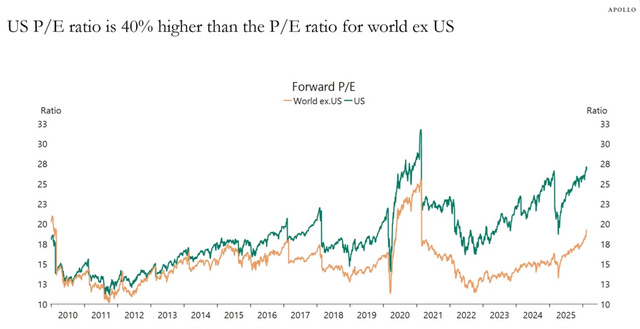
U.S stocks have diverged sharply from the rest of the world in terms of valuation, Apollo Global Chief Economist Torsten Slok notes. During the Financial Crisis “the P/E ratio for U.S. equities was similar to that of the rest of the world (VXUS) (VEU) (IXUS), but the surge in tech valuations has now pushed the US P/E ratio 40% higher,” Slok wrote in a note. See a screen of large-caps with the highest P/E (TTM).
We’ve all been there — a tense work meeting, an awkward text or that moment when your brain goes completely blank — you’re officially stuck. When you’re trying to get out of a tough situation sometimes all you need is a life raft in the form of the right thing to say, do or understand. That’s how I landed on what I now call the “anchor” prompt — a simple way to get unstuck in almost any situation. Instead of asking AI for more ideas, I ask it to make its help stick: one clear takeaway I can remember, one simple rule I can follow or something I could actually say out loud.
If you find Disky too minimal or not particularly useful, there’s another app worth checking out called SD Maid 2/SE. Unlike Disky, SD Maid 2/SE can help you clean not just internal storage but also cache files, and it lets you dig much deeper if you want. The app offers a clean interface with a delete button at the bottom that helps you free up space with a single tap. The bottom bar also shows how much space can be freed up instantly. In terms of features, SD Maid 2/SE offers quite a few tools, including CorpseFinder, which lets you find and delete leftover files and directories from apps that have already been uninstalled. Similarly, the SystemCleaner feature helps remove junk files, while the Deduplicator tool helps you get rid of duplicate files on your phone.
People who took suvorexant, a common treatment for insomnia, for two nights at a sleep clinic experienced a slight drop in amyloid-beta and tau, two proteins that pile up in Alzheimer’s disease. Related: Cancer May Emit Signals That Protect The Brain Against Alzheimer’s The trial was short and involved a small group of healthy adults, but the research – from Washington University in St. Louis – is an interesting demonstration of the link between sleep and the molecular markers of Alzheimer’s disease.
OpenAI is actively exploring alternatives to Nvidia’s latest AI chips in certain use cases, according to sources familiar with the matter, reflecting growing performance and scaling challenges as demand for advanced AI services accelerates. Sources indicate OpenAI has been assessing non-Nvidia hardware options since last year, driven in part by dissatisfaction with the speed at which current-generation Nvidia accelerators can deliver responses to users for more complex queries. While Nvidia’s GPUs remain central to large-scale AI training and inference, the issue appears less about absolute capability and more about efficiency, latency and throughput as models grow larger and workloads become increasingly demanding.
American kids ate very odd things in the 19th century. Spicy sauces and vinegary pickles. Shellfish and organ meats. Beets, rutabagas, collards. They even loved coffee. In historical documents of all kinds, from medical treatises to diaries to school records, Americans described children as curious omnivores who appreciated bold flavors and interesting textures. A group of children in 1830s Boston spent their pocket money on raw oysters, doused them with vinegar and pepper and “ate them with rapture.” A girl in 1870s New York adored a salad made of tiny crabs that she ate by the spoonful, shell and all. It was normal for a child to cheer when she saw turnips growing in the garden or for another to call cabbage his “delight.” The more I researched, the clearer it became that American children’s experiences with food in the past were full of pleasure. This was unrelated to socioeconomic status — children at every income level happily ate a diversity of foods.