
Remarkable 20

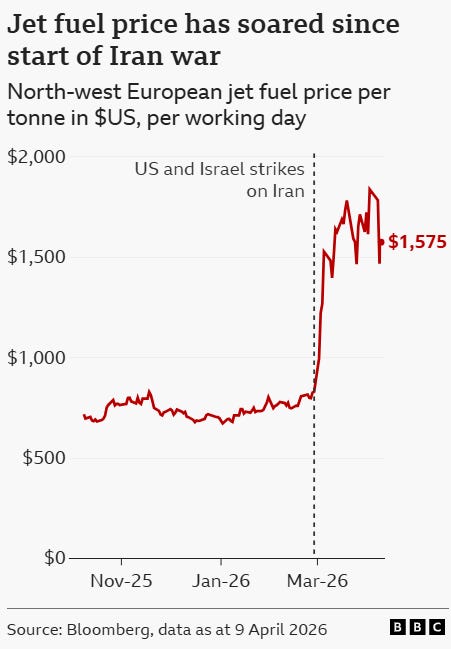
Europe will suffer jet fuel shortages in just three weeks if the the Strait of Hormuz does not reopen, the trade body for the continent’s airports has warned. The Persian Gulf is a major source of aviation fuel, accounting for about 50% of Europe’s imports… "A supply crunch would severely disrupt airport operations and air connectivity – with the risk of harsh economic impacts for the communities affected, and for Europe," ACI Europe's director-general Olivier Jankovec wrote in a letter to the European commissioners for energy and tourism.
EU airline industry warns of fuel shortages if Strait of Hormuz stays closed
Oil buyers are facing huge premiums for real-world oil barrels with prices surging to their highest levels since 2008, according to analysts at Morgan Stanley. The price of Dated Brent - which tracks the price of physical oil barrels in the North Sea - climbed above $141 over the Easter weekend, S&P analysts reported over the weekend. That is the highest level since the financial crisis. Martijn Rats, an analyst at Morgan Stanley, said in a note on Tuesday buyers were now swallowing “an exceptional premium for secure, refinery-usable Atlantic Basin barrels available now”. The cost is now well ahead of the prices being factored in to oil futures markets. Mr Rats said: “Different parts of the complex are pricing different combinations of immediacy, tightness and expected persistence.”
Iran energy shock ‘worse than all other oil crises combined’ - latest updates
US allies Japan, Thailand, South Korea and the Philippines have looked to broker deals with Iran to ensure the safe delivery of oil and natural gas. Asian countries are also buying up more natural resources from US rival Russia, while China has signaled its willingness to help alleviate fuel shortages and deepen energy collaboration with nearby economies such as Australia, the Philippines, and even Taiwan.
Desperate for fuel, US allies in Asia are turning to its adversaries instead
The global economy will be rocked by an even bigger interest rate shock than expected from war in Iran, JP Morgan’s boss has warned. Jamie Dimon, head of the world’s biggest bank, said on Monday that borrowing costs could be forced higher as the conflict in the Middle East
World not prepared for Iran war interest rate shock, warns JP Morgan boss Jamie Dimon
To imagine why resistance, even in the face of devastation, might be attractive, one need only imagine a soldier whose model of heroism is Imam Hussein, the grandson of the Prophet Muhammad and the figure most venerated in the Iranian state religion. Hussein is famous for being hacked apart by Sunnis at the Battle of Karbala in 680. Like the Battle of the Alamo for Texans, this bloody spectacle is for regime-loyal Shia the defeat that outshines in glory any possible subsequent victory. The Islamic Republic, by this standard, has already acquitted itself with honor, by continuing to fight even as their ships and aircraft are obliterated and their comrades blown apart.
Trump’s Stone Age Threat Will Lead to Tragedy
The current oil and gas crisis triggered by the blockade of the Strait of Hormuz is “more serious than the ones in 1973, 1979 and 2022 together”, Fatih Birol, the head of the International Energy Agency (IEA), told Le Figaro newspaper. “The world has never experienced a disruption to energy supply of such magnitude,” he said in an interview with the French newspaper released in its Tuesday edition.
IEA chief: current oil and gas crisis worse than 1973, 1979, 2022 together | Reuters
There will be no “mass exodus” of ships through the strait of Hormuz, shipping analysts say, despite a two-week conditional ceasefire being agreed between the US and Iran with provision for the temporary reopening of the crucial maritime channel. The ceasefire agreement “doesn’t change the situation in the sense that Iran is still in control”, said Richard Meade, the editor-in-chief at the maritime data provider Lloyd’s List Intelligence. “It still requires ships to essentially seek permission, and that’s the key. That means that nothing has changed – no permission, no transit.”
Ceasefire changes little for shipping in strait of Hormuz, experts say | Strait of Hormuz
Hugo Dixon, a columnist for Reuters, estimated that Tehran could earn $500bn over the next five years, creaming off profits for as long as it takes to construct new pipelines... In the near term, Iran’s enemies could use their own missiles to target the regime’s shadow fleet tankers, which are now transporting double the amount of oil they were before the war – and for almost double the profit...
Inside Iran, the IRGC would use oil funds to supercharge its ongoing takeover of the entire state, said Dr Andreas Krieg, a senior lecturer at the School of Security Studies at King’s College London. While the overall level of traffic through the strait would fall – sanctions bar Western firms from engaging in any business with the IRGC – the tollbooth windfall “would help to build a military dictatorship”. The IRGC would emerge as a “more radical, more empowered, more financially robust system that can go and build networks east with Russia and China”.
Tehran’s $500bn ‘tollbooth’ would change shape of Middle East forever
Now that the United States and Iran have declared a two-week cease-fire, the question is whether the war’s economic disruption will be short-lived or lasting. The lessons from history are sobering: In an interdependent global economy, the shock of the outbreak of war can produce long-term instabilities overnight, many of which become apparent only over time.
When the United States attacked Iran, it should have come as no surprise that Iran would blockade the Strait of Hormuz. Yet few could have foreseen the exact downstream effects: not just the worst disruption to oil supplies in history, but also shortages of materials that not many people realized they relied on — urea and ammonia used to grow the world’s staple food crops, helium for making computer chips and naphtha, a petroleum product crucial for the manufacture of many household plastic items, including garbage bags and water bottles..
I Studied the Economic Fallout From World War I. This Could Be Worse Than We Expect.
The vast data centers that power artificial intelligence guzzle huge amounts of energy but they also have another alarming impact, according to new research. They are creating “heat islands,” warming the land around them by up to 16 degrees Fahrenheit, and making life hotter for more than 340 million people.
Data centers are creating ‘heat islands’ and warming the land around them by up to 16 degrees
At AI protests and happy hours, inside start-ups and major companies, the tech world is in a frenzy over the same thing: Computers that make themselves smarter. Over the past year, the top AI companies have taken to loudly bragging about internal efforts to automate their own research. OpenAI recently released a new model it described as “instrumental in creating itself.” Within the next six months, the company aims to debut what it has described as an “intern-level AI research assistant.” Meanwhile, Anthropic says that as much as 90 percent of the company’s code is already written by Claude. “We are starting to see AI progress feed back on itself,” Nick Bostrom, an influential Swedish philosopher who studies AI risk, told us. Within Silicon Valley, many insiders believe that we are teetering on the precipice of a world in which AI can rapidly improve its own capabilities. Instead of waiting for months between new machine-learning breakthroughs, we might wait weeks. Imagine AI advancing faster and faster.
Silicon Valley Is in a Frenzy Over Bots That Build Themselves
For the past several weeks, Anthropic says it secretly possessed a tool potentially capable of commandeering most computer servers in the world. This is a bot that, if unleashed, might be able to hack into banks, exfiltrate state secrets, and fry crucial infrastructure. Already, according to the company, this AI model has identified thousands of major cybersecurity vulnerabilities—including exploits in every single major operating system and browser. This level of cyberattack is typically available only to elite, state-sponsored hacking cells in a very small number of countries including China, Russia, and the United States. Now it’s in the hands of a private company.
Claude Mythos Preview Is Everyone’s Problem
But in that brief aside, Scheffler finally articulated what he’s been trying to tell us for four years and what’s been his superpower all this time. Scottie Scheffler is never playing golf against the rest of the field. And he’s not even really playing 72 holes against the course. He’s truly just playing against the best version of himself at all times, and the only metrics he lives by are the shot he just hit and the shot he’s about to hit. It’s the type of line that can sound like self-help speak. Just be present. Stay in the moment. But it’s the key to unlocking Scheffler’s success. Because it’s completely accurate. Scheffler loves golf with such depth that he doesn’t play it for titles or even beating the guy next to him. It’s about trying to hit the next shot as well as he possibly can. Every round, and in turn every tournament, is really a golfer obsessing over each shot until it’s over.
Scottie Scheffler’s golf strategy: Why the PGA Tour star focuses on the micro
But it is not the success that makes Holloway part of this selection, rather the glory. No fighter in the featherweight division has more wins, more knockouts or more fight-time; no one, in any division, has landed more strikes, in title fights or in general; no one, in any division, has landed or absorbed more significant strikes. To watch Holloway compete is to experience extreme sensation. In 2019, the UFC minted a BMF belt with those invited to compete for it of elite ability but selected for purity of attitude. Roughly, they are fighters prepared to risk it all for joy, joy being a scrap as violent as possible that both participants seek to finish as spectacularly as possible. Even in the context, though, Holloway is special. Facing Justin Gaethje for the strap in 2024, he dominated for four rounds, four minutes and 50 seconds, but then, when the clappers went to signal the final 10, rather than await the judges’ verdict, he summoned his opponent – a bigger, heavier, more powerful man – to the centre of the octagon so they could stand and trade, then knocked him out face-planting cold with one second to go. No one had ever seen anything like it before; no one will ever see anything like it again.
The Joy of Six: moments of unbridled joy in sport | Sport | The Guardian
“I’m angry that they haven’t killed me. But I’m angry, above all, with myself, for getting into this mess.” Roberto Saviano is, as he twice says, angry. Twenty years after he wrote Gomorrah, Saviano is still living with the consequences. In 2006, that searing exposé of the Neapolitan mafia, the Camorra, became a bestseller, shifting 12 million copies worldwide; it inspired an award-winning film and a TV show of the same name (with a prequel series, Gomorrah: The Origins, coming to British screens this year).
Roberto Saviano interview on his life after writing the bestselling book Gomorrah