
Remarkable 26
A new collection of remarkable stories

Somebody should alert Senestech!
Irrigation canals around Boise have served as a rat superhighway, bringing an infestation so serious that health officials have floated declaring a public emergency.
In Idaho’s Suburbs, a Rat Invasion Tests the Limits of Small Government
When foreigners in China are used this way, they are called a baihouzi, a white monkey. They’re hired to help Chinese businesses appear more desirable, the foreigner association conveying prestige and a sense that your product is universally regarded. The industry is unregulated in China, operating in a legal grey area. White monkey positions are advertised on job boards and can fall into different categories, from acting and modelling for Chinese films and products to pretending to be the foreign CEO of a Chinese company to lend it credibility.
On Friday, Iranian military-linked media called on Tehran to impose fees on use of the undersea cables running through the Strait of Hormuz. Doing so would secure Iran’s control over the waterway and could generate billions of dollars, while giving Tehran fresh leverage over the West, Tasnim news agency said. The cables carry around 99 per cent of the world’s internet traffic, according to the ITU, the United Nations specialized agency for digital technologies. They also carry telecommunications and electricity between countries, and are essential for cloud services and online communications. “Damaged cables mean the internet slowing down or outages, e-commerce disruptions, delayed financial transactions... and economic fallout from all of these disruptions,” said geopolitical and energy analyst Masha Kotkin.
And the respite provided by the ceasefire has given Iran a chance to rebuild its armoury of killer drones, which are far cheaper and easier to make than missiles. “The ceasefire since April 7 has been good for them because it has allowed them to replenish their stocks,” says Prof Clarke, noting that Iran can produce drones much faster than America can replace its precision missiles and bunker-busting bombs.
Iran’s regime is confident of victory. It may be overplaying its hand
According to CPCA monthly retail data, the foreign brand share of new China passenger vehicle sales has fallen from approximately fifty percent in 2020 to roughly twenty seven percent in early 2026. The Beijing show makes you understand why in a way that no spreadsheet does.
Beijing Auto Show 2026: A Field Report from China’s Operational-Excellence Era
The reason this car matters for positioning is the price. Reported early Chinese-market estimates put the Z roadster between four hundred and five hundred thousand renminbi, which translates to roughly sixty to seventy thousand US dollars. BYD has already opened pre-orders on the closed Z9 GT in Europe at well over three times the China price (Electrek, April 2026). Even the European tag is a fraction of what a Porsche 911 Turbo, an Aston DB12 or a Ferrari Roma would cost for similar specifications. In the China market, at the China price, this is the most aggressive value-for-design proposition in the global luxury car business right now.
Beijing Auto Show 2026: A Field Report from China’s Operational-Excellence Era
Record-high US oil production has not accelerated since Trump took office, not even as oil prices have surged above $100 a barrel. US crude output increased to 13.7 million barrels per day last week, according to preliminary estimates from the Energy Information Administration. That’s little changed from 13.8 million at the end of 2025.
Trump has only one real option to slash gas prices
Fatih Birol, executive director of the Paris-based agency, said commercial reserves were being rapidly drained as oil and gas shipments from the Middle East continue to be blocked by the war in Iran. Speaking at a meeting of G7 finance ministers in Paris, Mr Birol warned there were only “several weeks” left of stored supplies at current rates of depletion.
Mr Birol, who is participating in the G7 finance leaders meeting in Paris, said the release of strategic oil reserves had added 2.5 million barrels of oil per day to the market, but said these reserves “are not endless”. He described “a perception gap in the markets between the physical markets and the financial markets” for oil. He said commercial inventories would last “several weeks, but we should be aware of the fact that it is declining rapidly”.
Oil supplies ‘depleting very fast’, warns energy chief
Outside the city of Thetford Mines, Quebec, in a region that once supplied the world with asbestos, workers are drilling underground in search of an unusual and potentially vast new source of clean energy. A start-up called Vema Hydrogen has drilled two test wells into the bedrock, each 1,000 feet deep, and is starting to inject treated water into the iron-rich rocks below. The goal is to trigger a special type of chemical reaction that could eventually produce large quantities of hydrogen, a clean-burning fuel that may one day play a vital role in tackling climate change. “The potential is massive,” said Pierre Levin, the chief executive of Vema, as he watched a drilling crew at work on a bright, bitterly cold spring day. “You can find rocks like this all over the world, enough to produce billions of tons of hydrogen.”
The Quest for Clean Hydrogen Moves Underground
The Iran war is doing more immediate damage to the economies of America, Europe and Japan via the bond markets than it is through the direct effects of the energy shock…
The oil shock has mushroomed into a larger bond crisis
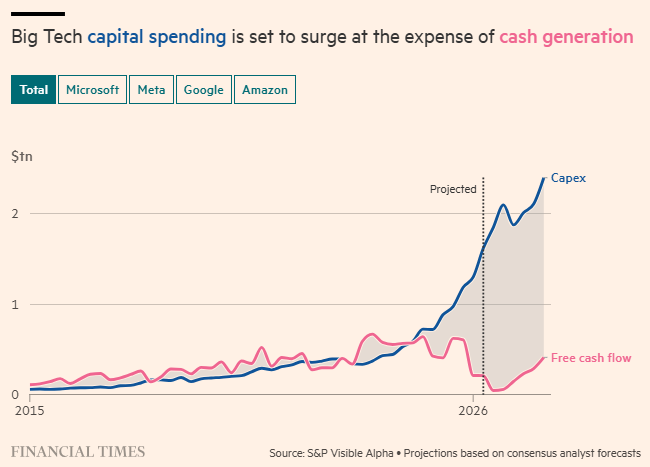
Just like Nebius, none of the other neoclouds have been able to demonstrate a profitable business model either, a fact that investors in this space would do well to remember. Furthermore, none of the hyper-scalers have demonstrated anything like material ROI on their massive AI-related capex up until this point as well. When you put this together with the fact that, at their core, Nebius sells a commodity product (AI-related compute) in an incredibly competitive industry where some of their biggest customers (e.g., Meta (META) and Microsoft (MSFT)) could turn around and become major competitors, things look really difficult when it comes to trying to prove out an attractively profitable business in the future.
Nebius Has Become Fully Untethered (NASDAQ:NBIS) | Seeking Alpha
In general, AI guidance can fall into one of two categories: attention signals and action signals. Attention signals flag decisions that are important without offering a recommendation: “This is a critical decision: pay close attention.” Action signals go further and prescribe a specific action: “Here’s what you should do.” In practice, both are widely used. In a hospital, for instance, an algorithm might alert a doctor that a patient’s vital signs are worsening with an attention signal that says, “Something’s wrong, take a look.” Or it might give an action signal, telling the doctor exactly what to do with a specific diagnosis and treatment recommendation. But which type of signal actually helps us make better decisions, especially when the AI is reliable and provides highly accurate advice?
Should AI Nudge You or Tell You What to Do? - Knowledge at Wharton
The report, launched at the Smart Ageing Summit in Oxford last week, argues that individuals have far greater control over their longevity than is commonly understood.
At least 80% responsibility for ill health in old age down to individual, study says
Artificial intelligence systems can now pass the Turing Test – better than a human being, a study has found. The Turing Test – founded by the pioneering mathematician, who called it the Imitation Game – is an experiment that is intended to check whether a machine can show the same intelligence as a human being. It has a human talk to unseen participants and see whether they can distinguish between human ones and artificial ones. Now a new study claims to have been the first to rigorously use modern large language models in a test. And it found that people thought the models were significantly more human than the real people who were part of the experiment.
AI can finally pass the Turing Test better than a human, study warns | The Independent
Offensive wars are ultimately judged not by lines on a map but on whether they meet the political aims for which they were launched in the first place. Putin’s war aims at the time of the invasion included the full subordination of Ukraine, weakening NATO as an alliance and restoring Russia as a dominant Eurasian power. Those aims are increasingly out of reach for Moscow. The battlefield and outcome of the war is now focused on the Donbas region of eastern Ukraine with no chance for Russian forces to seize Kyiv — Putin’s initial objective. The NATO alliance despite rhetorical critiques from Trump is larger today than when Russia invaded — Finland and Sweden have joined the alliance — and arguably stronger, with increases in defense spending throughout NATO’s European capitals. Thus, despite enormous and mounting losses for Russia, Putin has little to show for his war in Ukraine and the trends appear only to be worsening month by month.
Russia is losing in Ukraine. Xi has noticed — Trump should too
For investors in the sub-$2 billion market cap space, this is not an abstract macro story — it is an active margin event playing out across multiple sectors simultaneously. Regional trucking companies, last-mile delivery operators, and logistics providers are absorbing diesel costs that have risen sharply alongside gasoline, with limited ability to push surcharges through in a competitive environment. Consumer-facing small caps in food service, casual dining, and retail are getting squeezed from two directions: higher distribution and operating costs on one side, and a consumer with less disposable income after filling the tank on the other. Travel-adjacent small caps — regional hospitality operators, independent hotel brands, and leisure-focused consumer companies — face a more nuanced picture. Record travel volumes represent a genuine demand tailwind, but margin pressure from elevated fuel and labor costs can quickly offset volume gains for operators without significant pricing power. The companies best positioned on the other side of this trade remain domestic energy producers. With WTI holding above $100 and summer demand accelerating into a supply-constrained market, independent oil and gas operators in the small cap space continue to benefit from a price environment that shows no structural signs of easing before fall. The pump price this weekend is $4.56. If the Strait of Hormuz stays closed, it may look cheap by August.
let’s go back to 1980 — medium-term inflation expectations as measured by the Michigan survey were about nine percent — expected inflation over the next five to ten years was 9%. That was really bad. That said that people had basically internalized the inflation of the 70s and expected it to continue indefinitely. This meant that actually getting inflation back down to tolerable levels was very costly and very painful. In 2022, well, expected inflation over the next five years had crept up by a fraction of a percentage point, but it was still quite low. People were not at all building in anything like the expected inflation that prevailed before the great painful disinflation of the 1980s. And so I was quite confident that the dire predictions about what it would take to bring that inflation back down were wrong. Well, guess what? Especially in the last two months, expected inflation over the next five years has gone up a lot. It’s 3.9 percent in the latest Michigan release. That is, it’s not 1980 but it’s really bad. It’s the worst we’ve seen on that number since the early 1980s. It is saying that the person on the street is starting to believe after the tariff shock and now the Iran shock that we’re in a higher inflation environment. And we have to suspect that people making decisions about prices are thinking the same way. They’re going to start building those expectations into pricing. So we’re starting to get the thing that everyone in the economics biz fears, which is entrenched inflation. And if that’s happening, then the costs of the policy failures, the policy foolishness of the past year and a half are going to be a lot bigger than anyone is now reckoning. This is going to be an extremely painful situation that we have.
The United States is seeing an increasing concentration of wealth at the very top and a worsening national debt. For many Americans, taxing the rich more is an obvious move. Ask tax policy experts how to do this, and you will often hear novel proposals to curb the many intricate ways the rich make and hide their money: A wealth tax. A tax on unrealized gains. A tax on the loans that billionaires take against their stock. These ideas, now common in progressive tax thinking, come with serious catches, legal or arithmetical. The tax code has structural flaws, and many of the ideas would be good in theory. But pursuing them could result in little or no new revenue for the government. The boring truth is that Congress can accomplish a lot simply by raising the rates of the taxes already on the books.
The Simple Answer to Taxing the Rich Is the Best Answer
Some of my friends who actually work on this, like Henry Farrell, say that AI is a social technology. It’s basically agglomerating what lots of people have said. And it’s delivering back to you what a lot of people who know something about a subject would say if asked the question you asked. And it’s not understanding. There’s no mind there. But it is delivering a kind of aggregated, standard response. And a lot of jobs are like that. If you’re talking to the help desk at a call center somewhere thousands of miles away, the person that you’re talking to, if it is an actual person, may very well be there with a three-ring binder looking for what they’re supposed to say. And AI can replace that job. AI is basically doing much the same. A lot of people are doing fairly routinized, standardized work. It’s just the common opinion of common opinion responses to things as a way of doing their jobs.