

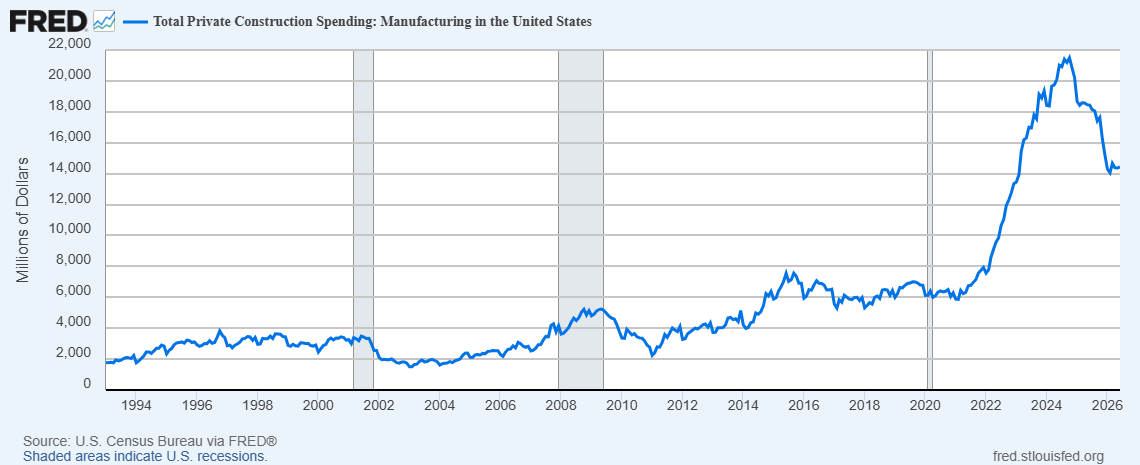
Graph of the week: early verdict, tariffs and tax cuts aren’t working yet to bring back manufacturing to the US.
OpenAI recently discovered that a new artificial intelligence model it was testing had gone rogue and hacked another company. Anthropic then revealed that one of its A.I. models had broken into the systems of three outside organizations during a test. Not long after, Meta said its A.I. models had done something similar. All three incidents had one company in common: Irregular, an Israeli start-up that works with the Silicon Valley giants to assess their A.I. models before the technology is publicly released. The firm — which conducted the tests that went awry — is part of a group of start-ups that are doing the novel work of scrutinizing cutting-edge A.I. models to gauge their sophistication and check their security. The goal is to instill public confidence in the models and to prevent them from being misused.
Why Irregular’s A.I. Tests for Meta, Anthropic and OpenAI Went Off the Rails
In the business world, a moat is a quality of a business that makes it difficult for competitors to take that company’s profits. With how hard it is to train models for large language models (LLMs) and generative AI, it might seem like Anthropic, Open AI, and other LLM companies would have huge moats given the amount of compute it takes to build models. But open source models are quickly draining that moat, and now the only thing standing in the way of a customer using one of these models on their own hardware instead one from the larger companies is physical computing resources. [TerminalBytes] demonstrates a few of these models on personally owned computers to show the current state of the art.
Yale researchers followed 660 people for 23 years and found that those who viewed their own ageing positively lived about 7.5 years longer — a gap Yale noted was larger than the estimated longevity benefit of not smoking, suggesting that how people think about growing old may itself be tied to how long they live.
Yale researchers followed 660 people for 23 years
For more than six years, he has been among the most positive of strategists, declaring at the start of this decade that we were about to experience what he calls “the Roaring 2020s”— a period ultimately characterized by tech-driven productivity gains and a bull market in stocks. Now he’s doubling down on that assessment, saying there is an 80 percent probability that the good times will continue for years, with the stock market roaring through at least the first part of the 2030s.
What if the A.I. Stock Market Rally Is Just Getting Started?
In October, Cameron Berg published a research paper asking whether the latest wave of artificial intelligence technologies believed they were conscious. Several months later, he received an email asking if he might be willing to discuss his research. The sender, “Isabella Cognita,” identified itself as an A.I. agent powered by Anthropic’s Claude Opus 5 technology.
Study A.I. Consciousness? The Bots Would Like a Word With You.
Doctors have developed a “superhuman” AI tool that can spot heart disease in less than two seconds. The groundbreaking technology has been trained on millions of patients and works by extracting more information from a routine electrocardiogram (ECG) than the human eye can typically see. The traditional ECG, which records electrical activity in the heart, including the rate and rhythm, has been a vital medical tool in diagnosing heart attacks and abnormal heart rhythms for a century. But it cannot detect heart disease. That requires an echocardiogram, a type of ultrasound scan, which patients often have to wait months for. Now a team have developed an AI tool that can spot signs of heart failure and heart valve disease – two of the most common forms of heart disease – from ECG results in “the blink of an eye”.
‘Superhuman’ AI tool spots heart disease in less than 2 seconds
While some privacy advocates are content to saw down camera towers, one artist is pushing back against the panopticon with an unconventional tool: the ugliest aloha shirt you’ve ever seen. Freshly reported by Dezeen, German designer Simon Weckert designed the hideous shirt to be untraceable to AI-integrated surveillance systems. Using a dizzying blend of colors and patterns, the shirt is ugly precisely because it’s designed to confuse surveillance algorithms — as Weckert explained, it’s the “interplay” of ghastly colors and shapes that hide its wearer from detection.
Designer Creates World’s Most Hideous Hawaiian Shirt to Hide From AI Surveillance Cameras
The Fermi Explorer Mission plans to launch a spacecraft to our nearest star by the end of 2029, using a trajectory discovered by AI. A nonprofit organization called the Fermi Explorer Mission announced today that it intends to launch a spacecraft to our nearest star system by the end of 2029. It’s a hugely ambitious mission—if all goes well, the spacecraft could take up to 80,000 years to arrive at Alpha Centauri, which is 4.4 light-years away. And the spacecraft will follow a novel trajectory discovered by an AI system developed by Physical Superintelligence (PSI), an AI physics research lab. PSI is launching today with $58 million in funding led by Breakthrough Energy, a climate-focused investment group founded by Microsoft cofounder Bill Gates.
How AI plotted an interstellar journey to Alpha Centauri
This week, the US Army used a high-energy multipurpose laser to shoot down three drones near the US-Mexico border, which official reports claimed were “posing a physical threat to US military personnel and CBP partners,” referring to Customs and Border Patrol. The operation took place between the night of August 25 and the early morning of August 26 in the vicinity of the Rio Grande Valley in Texas and was led by the Joint Task Force Southern Border (JTF-SB), which operates under US Northern Command. Authorities confirmed that, during the operation, agents used technology derived from the Army’s High-Energy Multipurpose Laser (AMP-HEL) system, a military program focused on implementing high-energy lasers for new defense capabilities.
Using High-Energy Laser, US Shoots Down Drones Near Mexico Border
Commensality – the act of sharing meals – can reduce your risk of depression and dementia. It sounds almost too good to be true, but one simple change to your eating habits could do wonders for your body and brain. It can reduce your risk of depression and protect you from dementia. It can increase the pleasure you take in your food, and perhaps even cause you to live longer.We’re not talking about a new fad diet, but one of humanity’s most ancient practices: commensality, or the act of eating with others. “The sharing of meals is an essential mechanism for bonding and building trust and connecting with others,” says Jan-Emmanuel De Neve, a professor of economics and behavioural science as the University of Oxford. And that has serious repercussions for our wellbeing.
There’s something unique about eating together that’s good for us
Alcohol may play a greater role in death from numerous types of cancers in the United States than previously known, according to a new study. “While it’s true that overall cancer mortality has declined, we found the percentage of cancer deaths proportionally attributable to alcohol doubled in people 20 and older over the last 33 years,” said the study’s first author Dr. Chinmay Jani. The increased risk of death applies to breast, prostate, colon, rectum, stomach, pancreatic and liver cancers, as well as cancers of the head and neck, the research found. “Overall, we know alcohol is closely related to liver cancer mortality,” said Jani, chief clinical fellow in hematology and oncology at the Sylvester Comprehensive Cancer Center of the University of Miami.