
Remarkable 6

Brendan Foody is 22 years old and runs a company worth billions. This August, I met the young CEO in a glass conference room overlooking the San Francisco Bay. While his peers are searching for their first jobs, Foody is pursuing a “master plan,” as he calls it, to upend the global labor market. His start-up, Mercor, offers an AI-powered hiring platform: Bots weed through résumés, and even conduct interviews. In the next five years, Foody told me, AI could automate 50 percent of the tasks that people do today. “That will be extremely exciting to see play out,” he said. Humanity will become much more productive, he thinks, allowing us to cure cancer and land on Mars.
Would You Trust a 22-Year-Old AI Billionaire With the Global Economy?
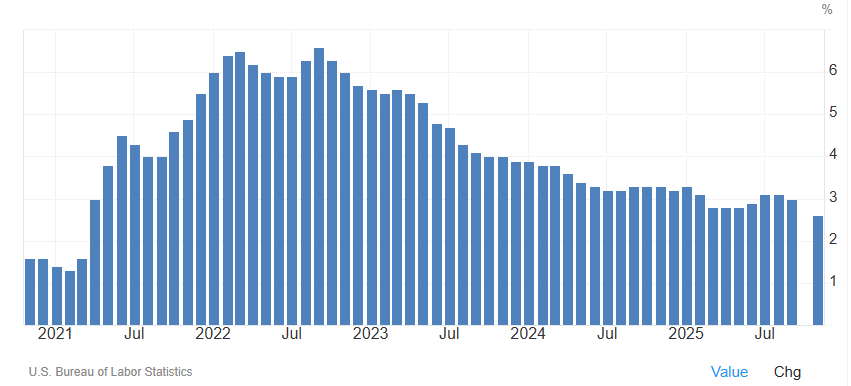
Core CPI:
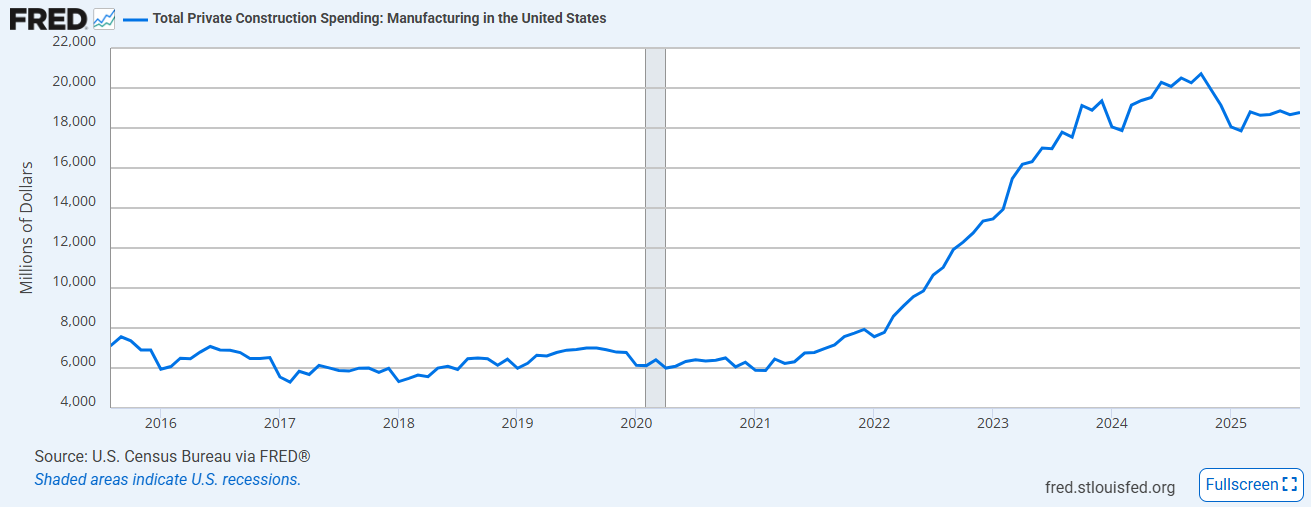
Manufacturing plant construction:
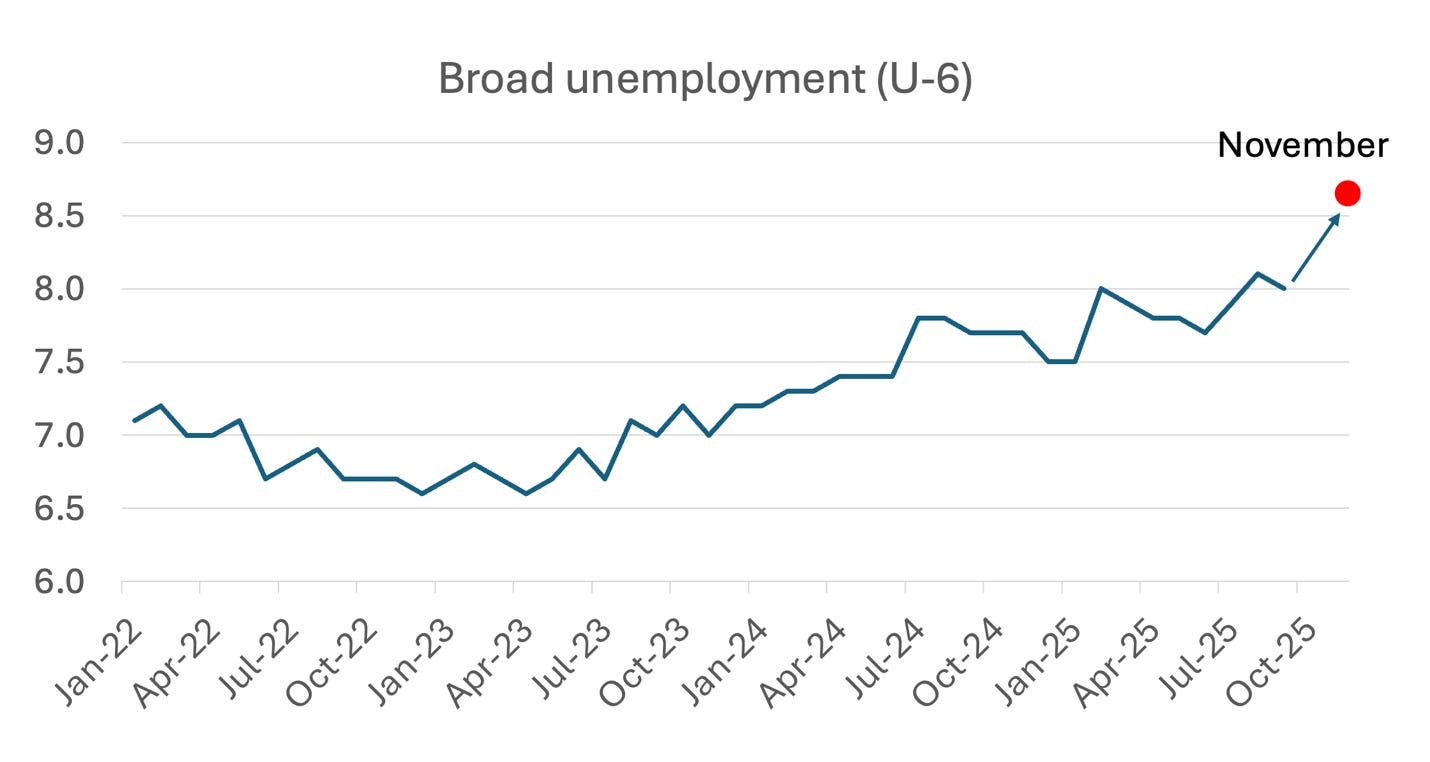
Broad unemployment:
Source: BLS
The government shutdown, which lasted 43 days from Oct. 1 to Nov. 12, was the most important cause of gaps in the collected data for the consumer price index calculation. As Swonk noted in a social media post, cutbacks at the BLS had already reduced the staff assigned to sampling prices by 25%. That prompted the agency to substitute “imputed” numbers for hard data. “Those cases can show up as zeros in the percent change of the release,” Swonk wrote - obviously lowering the bottom-line figure. A sampling scheduled for mid-October had to be canceled, so figures dating from August were used instead - concealing any price increases in subsequent months. A major problem concerns housing costs, which account for about one-third of the data inputs for the CPI. Because the BLS was unable to collect rental data for October, it implied that the monthly change in rents was 0% in October - further skewing the reported CPI lower. Experts say it will take at least six months to use newly collected data to provide a reliable estimate of housing inflation. The delay in sampling, Swonk adds, means that some seasonal price phenomena were missed. She points specifically to airfares - the originally scheduled sampling would have incorporated a pre-Thanksgiving run-up in fares, but by the time the data were collected fares had returned to a non-holiday level. Inflation data also are incorporated into GDP estimates - the lower the inflation rate, Swonk notes, the better the GDP looks. An artificially reduced inflation rate will translate into higher reported GDP growth.
I recently had a work session that completely changed my mind on UBI. We’ve been building internal AI infrastructure, and that meant wiring up MCP servers, basically tool and data connectors for models so they can operate inside real systems instead of hallucinating in a vacuum. I was using Claude Opus 4.5 as my coding and infra copilot via Claude Code. It wasn’t just “good at code.” It was good at the whole loop. It could read the repo, ask the right clarifying questions, map the dependency graph, propose a plan that didn’t suck, and then actually execute with minimal babysitting. It could generate server scaffolding, handle auth flows, write the docs, produce the deployment manifests, and then spot the places my assumptions were brittle. It felt less like autocomplete and more like pairing with a senior engineer who never gets tired and doesn’t mind trawling logs at 2 a.m. Halfway through, I caught myself staring at the screen thinking: oh shit, how in the world is “coding” going to be a job in a few years, if it’s already this good, and it keeps improving at this pace?
UBI or We’re All Screwed - Neural Foundry Substack
Robotics startup Foundation says it plans to manufacture 50,000 of its Phantom humanoid robots by the end of 2027, with some units destined for warehouses and others for the US military. At 5 feet 9 inches tall and 180 pounds, Phantom is designed to move seamlessly between domestic labor and warfare, a convergence that puts it among the most controversial machines under development today. In a recent interview, CEO Sankaet Pathak said that Phantom is built to be the “first body in… and deadly,” though lethal decisions would remain under human control, similarly to drones currently used in military operations.
This New Startup Plans to Deploy 50,000 Humanoid Robots by 2027
Big-ticket necessities, including health care, housing, and child care, became wildly unaffordable over the past few decades. Then COVID led to a gigantic surge in general inflation. Then borrowing costs went up sharply, making credit-card bills and auto loans more expensive. Then utilities started going bananas, in part thanks to the AI data centers popping up all over the place. Then the trade war pushed up the cost of clothing, food, and other goods. Then Congress let an important health-insurance-subsidy program expire, meaning 22 million Americans will see their premiums spike next month. Affordability is voters’ No. 1 issue by far. It propelled Trump back into office last year, as it propelled Zohran Mamdani, Mikie Sherrill, and Abigail Spanberger into office this year.
The Three-Step Guide to Fixing Affordability
The work here has highlighted a surprising connection between the loss of pigment in our hair and the mechanisms that can keep deadly cancers at bay.
Scientists find surprise link between grey hair and cancer
Hardware constraints may actually help drive innovation on the AI applications front. “China has the best open-source models in the world, despite not having the best silicon,” said Felix Wang, tech sector head at Hedgeye Risk Management. “China chipmakers and AI players may have an advantage over the US since they’re more adept at finding optimizations in those models.”
Chinese AI Euphoria Masks Long-Term Technological Challenges
The future of work on the factory floor just got a lot more hands. China’s home-appliance giant Midea Group has revealed what may be one of the most unusual robots to hit the manufacturing world: a six-armed humanoid machine on wheels. And it’s built to take on complex factory tasks. The robot, called MIRO U, made its public debut last week and is set to begin real factory work at Midea’s Wuxi washing machine plant before the month ends, according to reporting from the South China Morning Post (SCMP). At the launch, Midea CTO Wei Chang described the robot as a productivity breakthrough rather than a human-like novelty. He said, “The core value of MIRO U lies in moving beyond mere form imitation to achieve a leap in operational efficiency within industrial scenarios,” per SCMP. Unlike the typical two-armed humanoids showcased around the world, MIRO U uses six bionic arms mounted on a wheeled base. It also supports vertical lifting and 360-degree rotation, features aimed at handling multiple tasks in quick succession. According to SCMP, Midea expects the robot to boost production line changeover efficiency by about 30% once it joins operations at the Jiangsu province facility.
China Debuts Six-Armed ‘Super Humanoid’ Robot
This fall, Microsoft announced a series of deals, totaling tens of billions, to lease computer power for its artificial intelligence ambitions. Meta secured almost $30 billion in financing to build a massive data center in Louisiana without taking on the debt itself. Google also committed to rent computing power from a small company and then sell some of it to OpenAI. Those deals had one thing in common: They allowed companies that make massive quarterly profits to reduce their financial exposure to the frenetic, global buildup of data centers.
How Tech’s Biggest Companies Are Offloading the Risks of the A.I. Boom
In a world where new streaming platforms seem to launch every month (and the ones you’ve already signed up for are hiking up their prices almost as frequently), one simple device is offering access to pretty much everything you could ever want to watch. You just have to get in touch with a friend of a friend, or follow a dubious link on a pop-up-laden website, hand over a one-off fee, and you’re sorted. Or so you think… The only catch? It’s completely illegal. Using modified sticks to stream content that you’re not paying for violates the Fraud Act of 2006.
How did ‘dodgy stick’ streaming become such a socially acceptable crime?